ImpactStar software is a comprehensive system designed for digital control, data acquisition, and analysis in Charpy, Izod, and drop weight impact testing equipment.
It operates in a Windows® environment with an intuitive interface and advanced analysis tools that simplify equipment operation and result interpretation.
⚙️ Main Features
Full digital control of equipment functions.
Batch operation or individual testing with automated management.
Graphical analysis of impact curves (energy, time, velocity, angle).
Flexible configuration of test parameters.
Multi-level security management with protected operator and administrator access.
User-friendly and versatile window-based interface.
Automatic control program that optimizes the testing sequence.
Automatic report generation with results and graphs.
Database management and storage for complete traceability.
💡 Advantages
Simplifies test operation and automation.
Improves test accuracy, repeatability, and documentation.
Facilitates traceability and auditability of results.
Compatible with PTS ITA, ITD, ITC, XJC, and CHK Series equipment.
Complies with international ASTM, ISO, DIN, and EN standards.
🧪 Aplications
Control and monitoring of Charpy and Izod testing.
Statistical analysis of impact test results.
Management of quality control and material research laboratories.
High reliability – High efficiency – Modular structure for a wide range of applications
.
📘 General Description
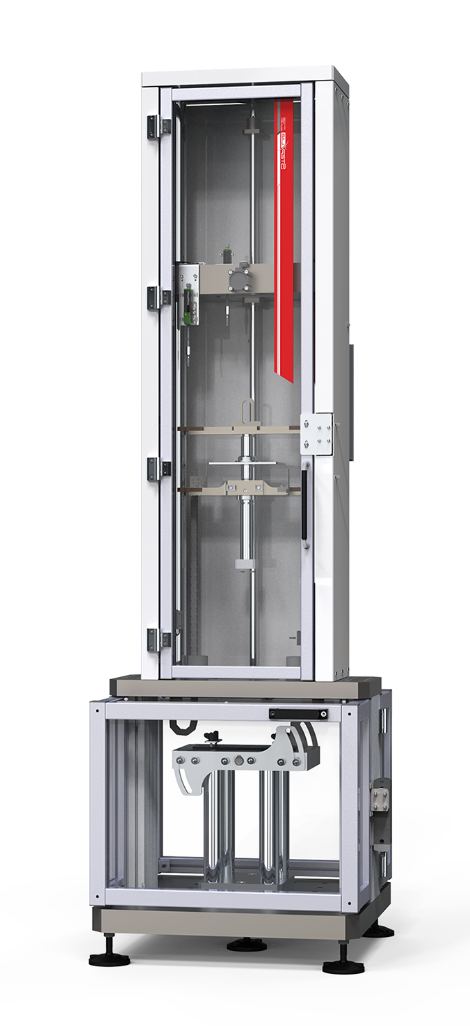
The DW750 system operates by free fall with pneumatic release.
The DW750 Free Fall Drop Weight Impact Tester is designed to perform impact testing on plastics, composites, films, and industrial components.
It operates under the free-fall weight principle and complies with international standards ASTM D3763, ASTM D4272, ASTM D5628, ISO 6603-2, and ISO 7765-2.
Its robust structure, measurement accuracy, and digital control ensure repeatable results in impact tests at different energy levels and drop heights.
This model incorporates the ImpactStar software, which allows equipment control, data acquisition, and automatic report generation.
🧩 General Features
STEP Lab impact testing systems (integrated into the DW series) are designed to perform single-axis or multi-axis impact tests on products and standardized specimens.
These systems offer a wide energy capacity ranging from 0.2 to 2000 J, allowing the testing of a wide variety of materials and components.
Their modular design and large internal working area enable the placement of specimens of different sizes.
The equipment can be complemented with a wide range of optional accessories, including:
Instrumented load cells
Anti-rebound systems
Spring accelerators
Interchangeable impactors and specimen holders
⚙️ Main Technical Specifications
Parameter
Value
Drop height
0.04 – 1.4 m
Impact velocity (without acceleration)
5,0 m/s
Impact velocity with acceleration
20.0 m/s (with optional acceleration)
Velocity measurement
High-precision optical sensor
Energy range
Up to 750 J
Standard drop weight
55 kg
Drop weight with acceleration
12.5 kg (at 10 m/s)
Signal acquisition speed
14 MHz
Signal resolution
16 bits
Foot loading point
12.000 N/cm²
Compressed air pressure
6 – 8 bar
Test area (W × D × H)
400 × 400 mm
Overall dimensions (W × D × H)
780 × 600 × 2500 mm
💻 Control System and Software
The ImpactStar software provides complete test control and data management:
Fully digital and automated controI
Individual or batch test acquisition
Load-time curve analysis
Easy parameter adjustment
Multi-level safety management
Automatic report generation
Integrated database and result export
🧰 Standard Accessories
Interchangeable hammers and anvils according to standards
Infrared / optical speed detector
ImpactStar software with graphical user interface
Protective safety cage system
Supports for different specimen types
⚗️ Applications
Single-axis or multi-axis impact testing on plastic, composite, or metallic materials
Evaluation of absorbed energy and impact behavior
Quality control, certification, and product development
Research on fracture resistance and crack propagation under dynamic conditions
¿que es un pendulo de impacto caída libre? Las Torres de Caída de Peso son sistemas diseñados para realizar pruebas de impacto monoaxiales y multiaxiales en productos o especímenes normalizados. Permiten ajustar energías de impacto entre 5 y 2000 julios (J), lo que posibilita ensayar una amplia variedad de materiales y componentes. Gracias a su estructura modular y amplia zona de ensayo, pueden adaptarse a diversas necesidades industriales y actualizarse fácilmente.
Aplicaciones: Ensayos en productos terminados: equipos deportivos (botas de esquí, patines, snowboard) y componentes automotrices. Pruebas según normas internacionales: ISO 6603-2, ISO 7765-2, ASTM D 3763, ASTM D 3029 (Método B), ISO 8256 A, CAI Test Boeing BSS 7260, Airbus AITM 1.0010, Charpy ISO 179 y ISO 148-1. Ensayos rotura/no rotura o instrumentados (adquieren fuerza y energía absorbida).
High reliability – High efficiency – Modular structure for a wide range of applications
.
📘 General Description
Automatic weight recovery system and velocity measurement.
The DW 1000 Free Fall Drop Weight Impact Tester is designed to perform high-energy impact tests on plastics, composites, metals, and structural components.
It operates using the free-fall weight principle and complies with international standards such as ASTM D3763, ASTM D4272, ASTM D5628, ISO 6603-2, and ISO 7765-2.
Its digital control system and optical velocity measurement ensure maximum precision, repeatability, and safety.
This model incorporates the ImpactStar software, which enables advanced data acquisition and analysis, test management, and automatic report generation.
🧩 General Features
STEP Lab impact testing systems, integrated into the DW series, are designed for single-axis or multi-axis impact testing on products and standardized specimens.
These systems allow testing with energies ranging from 0.2 to 2000 J, making them ideal for a wide range of materials and industrial applications.
Their robust design and large testing chamber facilitate the placement of specimens of different dimensions.
Additionally, the equipment can be complemented with a wide range of optional accessories, such as:
Instrumented load cells
Anti-rebound systems
Spring accelerators
Interchangeable impactors and specimen holders
⚙️ Main Technical Specifications
Parameter
Value
Drop height
0,05 – 1,4 m
Impact velocity (without acceleration)
5,0 m/s
Impact velocity with acceleration
10,0 m/s
Velocity measurement
High-precision optical sensor
Energy range
Up to 1000 J
Standard drop weight
70 kg
Drop weight with acceleration
20 kg (at 10 m/s)
Signal acquisition speed
3,5 MHz
Signal intensity resolution
16 bits
Foot loading point
16.000 N/cm²
Compressed air pressure
6 – 8 bar
Test area (W × D × H)
800 × 1400 × 650 mm
Overall dimensions (W × D × H)
800 × 1400 × 3500 mm
Equipment weight
1100 kg
💻 Control System and Software
The ImpactStar software operates in a Windows environment and provides an intuitive user experience with powerful analysis and control capabilities.
Main functions:
Complete digital control of the test
Individual or batch test execution
Force-time and absorbed energy curve analysis
Flexible parameter configuration
Multi-level safety management
Intuitive touchscreen graphical interface
Automatic report generation and integrated database
🧰 Standard Accessories
Interchangeable hammers and anvils according to international standards
Optical velocity detector
ImpactStar software with graphical result visualization
Safety cage protection system
Adaptable supports for specimens of different sizes
⚗️ Applications
Single-axis or multi-axis impact testing on plastic, metallic, or composite materials
Determination of absorbed energy, deformation, and impact resistance
Quality control, product development, and material validation
¿que es un pendulo de impacto caída libre? Las Torres de Caída de Peso son sistemas diseñados para realizar pruebas de impacto monoaxiales y multiaxiales en productos o especímenes normalizados. Permiten ajustar energías de impacto entre 5 y 2000 julios (J), lo que posibilita ensayar una amplia variedad de materiales y componentes. Gracias a su estructura modular y amplia zona de ensayo, pueden adaptarse a diversas necesidades industriales y actualizarse fácilmente.
Aplicaciones: Ensayos en productos terminados: equipos deportivos (botas de esquí, patines, snowboard) y componentes automotrices. Pruebas según normas internacionales: ISO 6603-2, ISO 7765-2, ASTM D 3763, ASTM D 3029 (Método B), ISO 8256 A, CAI Test Boeing BSS 7260, Airbus AITM 1.0010, Charpy ISO 179 y ISO 148-1. Ensayos rotura/no rotura o instrumentados (adquieren fuerza y energía absorbida).
High reliability – High efficiency – Modular structure for a wide range of applications
.
📘 General Description
Automatic weight recovery system and velocity measurement.
The DW 2000 Impact Tester is designed to perform high-energy impact tests on metallic materials, plastics, composites, and industrial components.
It operates using the free-fall weight principle with optical velocity measurement and digital control, ensuring precision, safety, and repeatability in every test.
This model belongs to the STEP Lab series, specialized in single-axis and multi-axis impact testing, with a maximum energy capacity of 2000 joules, making it ideal for demanding tests in research laboratories, quality control, and advanced material development.
🧩 General Features
STEP Lab impact testing systems are versatile equipment designed to perform single-axis and multi-axis impact tests on a wide range of materials and products.
They allow impact energies ranging from 0.2 to 2000 J, covering everything from lightweight plastic materials to high-strength structural components.
Their design provides a large usable testing volume, facilitating the positioning of large or non-conventional specimens.
In addition, the system supports a wide range of accessories that enhance its functionality:
Instrumented load cells and impactors
Anti-rebound and safety systems
Spring accelerators for multiple impacts
Interchangeable specimen holders and anvils
⚙️ Main Technical Specifications
Parameter
Value
Drop height
0,05 – 1,4 m
Impact velocity (without acceleration)
5,0 m/s
Impact velocity with acceleration
20,0 m/s
Velocity measurement
High-precision optical sensor
Energy range
Up to 2000 J
Standard drop weight
70 kg
Drop weight with acceleration
40 kg (10 m/s) / 10 kg (20 m/s)
Signal acquisition speed
3,5 MHz
Signal intensity resolution
16 bits
Foot loading point
22.000 N/cm²
Compressed air pressure
6 – 8 bar
Test area (W × D × H)
800 × 1400 × 650 mm
Overall dimensions (W × D × H)
800 × 1400 × 3500 mm
Equipment weight
1400 kg
💻 Control System and Software
The ImpactStar software controls equipment operation and manages real-time data acquisition.
It operates in a Windows environment and integrates an intuitive touchscreen interface with powerful analysis and automatic reporting tools.
Key features:
Complete digital control of the test
Execution of individual or batch tests
Visualization and analysis of force-time and absorbed energy curves
Configuration and calibration by user access levels
Automatic PDF or Excel report generation
Database management and historical test record storage
🧰 Standard Accessories
Interchangeable impactors and anvils according to ASTM and ISO standards
Optical velocity measurement system
ImpactStar software with touchscreen graphical interface
Safety protection cage system
Adjustable specimen holders for different test geometries
High-precision calibrated load cells and instrumentation
⚗️ Applications
Single-axis or multi-axis impact testing on metallic, plastic, and composite materials
Evaluation of absorbed energy, deformation, and impact resistance
Testing of automotive, aerospace, and industrial components
Research and development of new structural materials
¿que es un pendulo de impacto caída libre? Las Torres de Caída de Peso son sistemas diseñados para realizar pruebas de impacto monoaxiales y multiaxiales en productos o especímenes normalizados. Permiten ajustar energías de impacto entre 5 y 2000 julios (J), lo que posibilita ensayar una amplia variedad de materiales y componentes. Gracias a su estructura modular y amplia zona de ensayo, pueden adaptarse a diversas necesidades industriales y actualizarse fácilmente.
Aplicaciones: Ensayos en productos terminados: equipos deportivos (botas de esquí, patines, snowboard) y componentes automotrices. Pruebas según normas internacionales: ISO 6603-2, ISO 7765-2, ASTM D 3763, ASTM D 3029 (Método B), ISO 8256 A, CAI Test Boeing BSS 7260, Airbus AITM 1.0010, Charpy ISO 179 y ISO 148-1. Ensayos rotura/no rotura o instrumentados (adquieren fuerza y energía absorbida).
Ductility and Anisotropy Tester for Metal Sheets and Strips
Erichsen cupping Tester
⭐ What is the GBS-60B and what is it used for?
The GBS-60B is a specialized instrument designed for ductility and anisotropy testing of metal sheets and strips, especially non-ferrous materials.
It is designed to evaluate how a material behaves when subjected to plastic deformation, allowing users to determine its ability to stretch, bend, and withstand stress without failure.
It is widely used in:
Metallurgical laboratories
Automotive industry
Sheet metal manufacturing
Quality control of rolling and forming processes
🔧 What tests does the GBS-60B perform?
The equipment is designed for two main types of testing:
1. Basic Ductility Test (Ball or Punch Penetration)
Esta prueba determina la capacidad del material para deformarse antes de romperse.
🔹 Procedure:
The system uses a steel ball or steel punch of a specified dimension to compress the specimen, which is clamped with a force of 10 kN.
The force is applied until the specimen is penetrated.
The penetration depth of the steel punch into the specimen represents the ductility value of the tested sample, and this value is used to estimate the material’s plastic deformation capability.
🔹 What does this test determine?
Resistance to plastic deformation
Material behavior under impact or pressure loads
Ease of material processing (stamping, bending, rolling)
2. Ductility and Anisotropy Test for Non-Ferrous Materials
This test evaluates how the material deforms in different directions.
🔹 Procedure:
The ductility test is a method that uses a punch column of a specified size to impact a round plate with a defined external diameter, positioned between a clamping die and a ductility testing die.
The round plate stretches along the radial direction and bends under the pressure of the punch, forming a cup shape. During this process, two symmetrical protrusions known as “ears” are formed along the edge of the cup. The anisotropy of the material is evaluated by measuring the ear height ratio.
🔹 What does this test determine?
Material anisotropy (differences in properties depending on rolling direction)
Sheet uniformity
Material capability for deep drawing without failure
Ear height measurement allows identification of the directional behavior of mechanical properties, essential for deep drawing processes
⭐ Why is the GBS-60B important?
✔ Detects rolling and heat-treatment defects ✔ Helps select materials with improved stamping capability ✔ Ensures quality in metal forming processes ✔ Essential for predicting failures caused by low ductility

 +52 33 3817 0140 | +52 33 3817 8122










 (Agrandar)


 ¡Welcome!
 WhatsApp,
 leave us a message on the fixed
 Chat icon.




